Have you decided to make your home “smart”? Then choosing the right smart outlet is a necessary and important step in this process. How do smart outlets differ, what characteristics do they have, and what should you look for when choosing one?
Ecosystem
Obviously, a smart outlet must be compatible with the smart home ecosystem you want to set up. Let’s take a look at the most common and popular ones.
Xiaomi smart home. A huge range of devices, including ready-made kits with a hub, sensors, light bulbs, door locks, cameras, etc. Xiaomi devices are easily integrated into smart homes from Aqara and support voice control using Google Assistant, as well as through the Mi Home app. Communication between devices is provided via ZigBee, Wi-Fi, or Bluetooth protocols.
Apple smart home. Smart devices from Apple can be controlled using the HomeKit software platform. In this case, HomePod, HomePod mini, or Apple TV speakers serve as the hub. Control via the proprietary app and integration with gadgets from other manufacturers is also available. Communication protocols: Wi-Fi, Bluetooth, Matter.
Google Home smart home. The center of the ecosystem is the Google Home/Home Mini smart speaker. Google Assistant helps you control all your gadgets, and you can view camera footage and event logs in the mobile app. Google Home supports the Matter communication protocol (Wi-Fi, Bluetooth) and is compatible with most third-party devices.
There are many ecosystems on the market. Not all of them can boast a huge number of devices or their own voice assistant, but they are still worth mentioning. These include the Livicom Smart Home, HIPER Smart Home, Hommyn Smart Home, and others.
How a smart outlet works
Zigbee. A radio communication protocol created specifically for smart home devices. It is distinguished by its low power consumption, autonomy (devices can operate for a long time on regular batteries), and reliability. Each element that supports this protocol automatically becomes a repeater, ensuring uninterrupted system operation.
Z-Wave. An older technology similar to Zigbee. The protocol uses radio waves for wireless data transmission, creating a repeater network with a range of up to 100 m and providing a reliable connection. It consumes little energy. The main advantage is the full compatibility of any devices that support this protocol. The disadvantage is the higher cost of these devices.
Thread. A protocol that incorporates all the best features of previous generations of communication standards, namely: low energy consumption (long battery life), creation of a relaying mesh network, reliable AES data encryption, and the ability to connect to cloud storage via 6LoWPAN technology. On the downside, devices need to be set up beforehand. By default, they don’t support interaction with each other.
The protocol can work over Wi-Fi, Ethernet, and Bluetooth, as well as autonomously through a common hub that doesn’t need Internet access. Dotdot technology (similar to Zigbee) is used for this. It is also possible to separate devices: those that need fast Internet can use Wi-Fi, while energy-efficient devices will work through Thread hubs.
Type
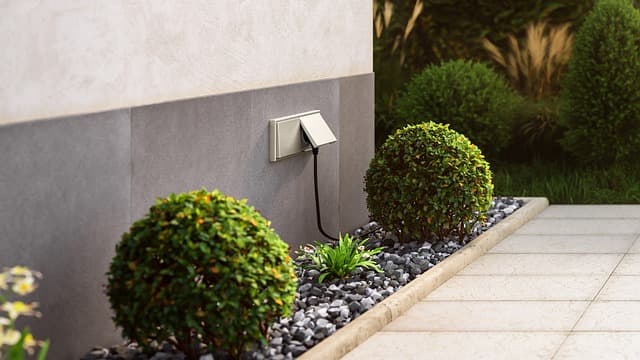
There are two types of smart sockets: built-in and external. The former are installed like ordinary sockets in the wall, while the latter are simply plugged into a regular socket.
Functions
The main options that make a socket “smart” are the automatic switching on/off of devices. It does this using the functions described below.
Timer/autonomous timer. Most sockets are equipped with a timer and can switch devices on/off according to a pre-planned scenario.
Scenario/schedule settings. Allows you to create scenarios/schedules according to which electrical appliances will turn on, operate, and then turn off.
Remote control of devices. An essential feature that allows you to control connected devices via the internet using a mobile app.
Voice control support. Allows you to control the device using a voice assistant.
Energy consumption monitoring/energy consumption recording/energy monitoring. Allows you to track how much electricity a device connected to the outlet has consumed. This information can be found in the proprietary app.
Automatic saving of settings when the power is turned off. Useful if you often experience power outages.
Voltage control/power and voltage meter. Allows you to monitor the power and voltage levels in the outlet.
Protection
IP20. This means that the outlet is protected against the ingress of solid objects with a diameter of at least 12.5 mm and is not protected against moisture ingress into the enclosure.
Overload protection. If the electric current exceeds the permissible values, the smart outlet will simply shut down and will not be damaged.
Electric shock protection. Protects the user from electric shock.
Surge protection. Protects the device in case of voltage fluctuations.